
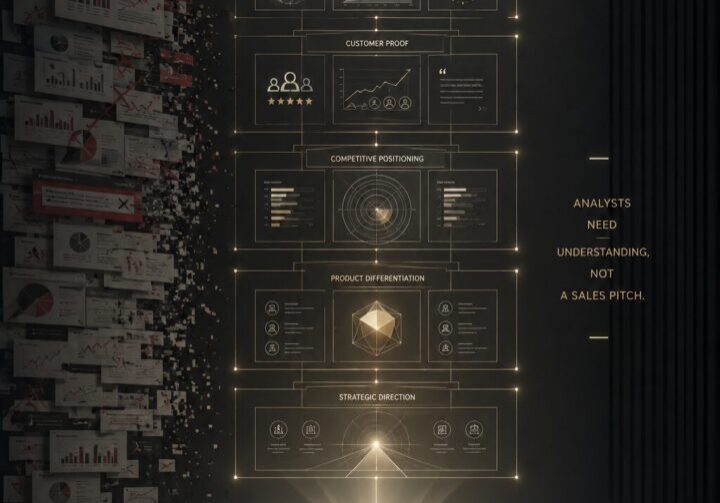

Getting an analyst briefing on the calendar can feel like an accomplishment, particularly for companies entering a category dominated by established competitors. But securing the meeting is only the beginning. Analysts are not journalists, prospective customers, or investors, and treating them like any of those audiences can undermine the conversation quickly. A strong analyst relations program depends on helping analysts understand where a company fits in the market, why its approach matters, and what evidence supports its claims. For companies preparing for their first briefing, these nine mistakes can make an important opportunity far less valuable.
1. Treating the Briefing Like a Sales Pitch
Analysts are not prospects waiting to be closed. They want to understand the company, product, market strategy, competitive environment, and relevance to the categories they research. Turning the briefing into an aggressive product pitch wastes time that could be spent establishing strategic context. The strongest presentations educate first and allow differentiation to emerge through substance.
2. Spending Too Long Explaining the Company
Company history matters, but analysts rarely need fifteen slides explaining how the organization was founded. They need enough context to understand the business before moving into the market problem and strategic differentiation. Excessive corporate background consumes valuable briefing time. Keep the introduction disciplined and move quickly toward information the analyst can actually use.
3. Briefing the Wrong Analyst
Analyst relevance matters more than analyst prominence. Companies sometimes pursue the most recognizable analyst without examining whether that person’s research agenda actually intersects with their market. That creates an awkward conversation and reduces the likelihood of meaningful follow-up. Effective analyst relations begins with mapping firms and individual analysts against the company’s actual category, customers, competitors, and growth priorities.
4. Assuming the Analyst Already Understands Your Category
Emerging companies frequently operate in markets where terminology and category boundaries remain unsettled. Leadership may use certain terms internally every day and assume the analyst defines them identically. That assumption can create confusion about competitors, use cases, and market position. Establishing category context early gives the analyst a clear framework for interpreting everything that follows.
5. Making Competitive Claims Without Evidence
Saying a product is faster, safer, easier, or more innovative than competitors is not particularly useful without supporting evidence. Analysts evaluate markets professionally and are accustomed to hearing ambitious claims from vendors. Customer results, deployment data, product capabilities, and credible comparative evidence make differentiation more persuasive. Assertions unsupported by proof can make the rest of the presentation harder to trust.
6. Trying to Control the Analyst’s Conclusion
Companies sometimes enter briefings expecting analysts to validate their positioning immediately. That misunderstands the purpose of the engagement. Analysts maintain their own methodologies, perspectives, and research priorities, and they may interpret the market differently than the company does. The objective should be to improve understanding, not engineer a predetermined endorsement.
7. Bringing Too Many People Into the Meeting
A large internal audience can make a briefing cumbersome. Multiple executives may compete to answer questions, introduce conflicting terminology, or consume time with unnecessary detail. Every participant should have a defined role and a clear reason for attending. A smaller, prepared team usually produces a more coherent conversation and gives analysts clearer access to relevant expertise.
8. Failing to Prepare for Difficult Questions
Analysts often know the competitive landscape extremely well. They may challenge market assumptions, question differentiation, probe customer adoption, or identify competitors leadership hoped to avoid discussing. Defensive responses weaken credibility and can expose gaps in positioning. Preparing executives for difficult questions should therefore be treated as seriously as preparing the presentation itself.
9. Treating the Briefing as a One-Time Event
One briefing rarely creates meaningful analyst influence by itself. Markets evolve, products change, customers accumulate, and company strategy matures. Analysts need substantive updates over time if they are going to maintain an accurate understanding of the organization. The first briefing should establish the foundation for an ongoing relationship rather than function as a single transaction.
Analyst briefings are most valuable when companies stop approaching them as presentations to win and start treating them as opportunities to establish informed market understanding. The goal is not to leave the meeting with immediate validation. It is to ensure the analyst understands the company’s position, differentiation, evidence, and direction well enough to place it accurately within the market. Companies that approach analyst relations with that longer horizon create significantly more value from every subsequent interaction.