
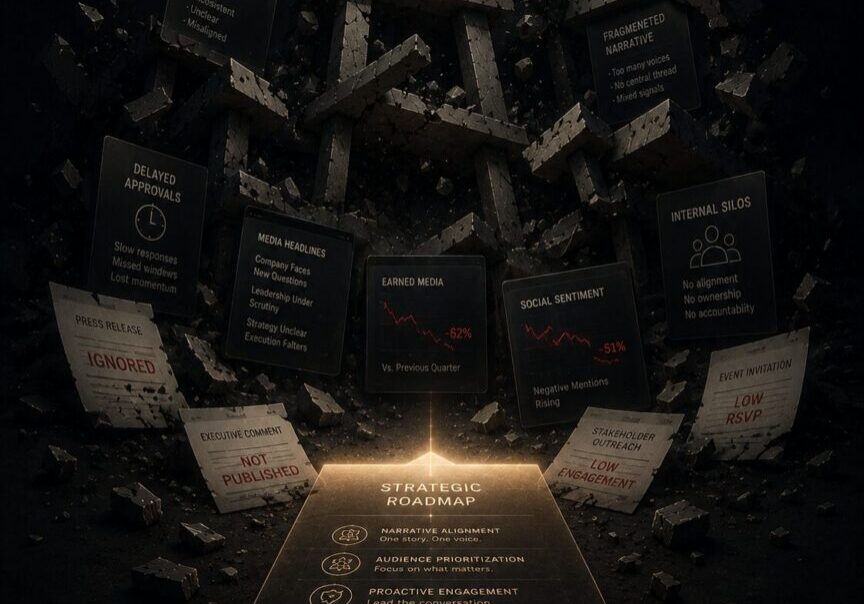

Hiring a PR agency is often seen as a turning point. A company brings in experienced professionals, invests meaningful budget, and expects momentum: stronger media coverage, clearer positioning, increased visibility.
And yet, in some cases, PR can underperforms.
Not because the agency is incapable.
Not because the company lacks a story.
But because the underlying conditions for success were never aligned.
PR doesn’t fail at the surface. It fails at the foundation.
Here’s where that breakdown usually happens.
The Narrative Was Never Clear to Begin With
The most common issue is also the least acknowledged: the company doesn’t have a sharp, external-facing narrative. Internally, everything feels clear from product, roadmap, to differentiation. But externally, the story lacks precision:
- What problem is being solved?
- Why does it matter now?
- Why is this company uniquely positioned?
Without that clarity, even strong media outreach struggles. A good agency can amplify a story. It cannot fix one that isn’t defined. This is why messaging and positioning work often determines PR success before outreach even begins.
Expectations Are Misaligned From Day One
Many PR relationships start with vague or unrealistic expectations:
- “We want more press”
- “We need visibility”
- “We want to be seen as leaders”
These are outcomes, not strategies.
Without defining:
- Target audiences
- Priority narratives
- Tiered media goals
- Success metrics beyond volume
PR becomes activity without direction. The result is motion, not momentum.
The Company Treats PR as Output, Not Input
Strong PR requires access:
- Product developments
- Customer insights
- Leadership perspective
- Internal strategy shifts
When companies limit access or only share polished updates the agency operates with incomplete context.
That leads to:
- Surface-level storytelling
- Generic pitches
- Missed opportunities for timely commentary
The best PR programs function as embedded strategic partners, not external vendors.
Speed and Timing Are Off
Modern media operates on compressed timelines.
According to insights from Pew Research Center, newsroom resources are shrinking while output demands are increasing. That means:
- Less time to evaluate stories
- Higher expectations for clarity
- Faster response cycles
If a company cannot:
- Approve quickly
- Provide commentary rapidly
- Engage in real time
even strong opportunities disappear.
PR success increasingly depends on organizational responsiveness, not just agency effort.
There’s No Consistent Drumbeat
PR is not a one-time event. Companies often expect results from:
- A launch
- A funding announcement
- A single campaign
But visibility builds through repetition:
- Thought leadership
- Commentary
- speaking programs
- awards strategy
- consistent narrative reinforcement
Without that cadence, even strong moments fade quickly. This is where integrated programs outperform isolated efforts.
PR failure is rarely about hiring the wrong agency.
It’s about:
- unclear narrative
- misaligned expectations
- lack of access
- slow execution
- inconsistent visibility
When those issues are addressed, good agencies become effective ones. And PR shifts from unpredictable to repeatable. Because at its core, PR isn’t about generating attention.
It’s about making sure the right story is understood consistently, clearly, and at the right time.