
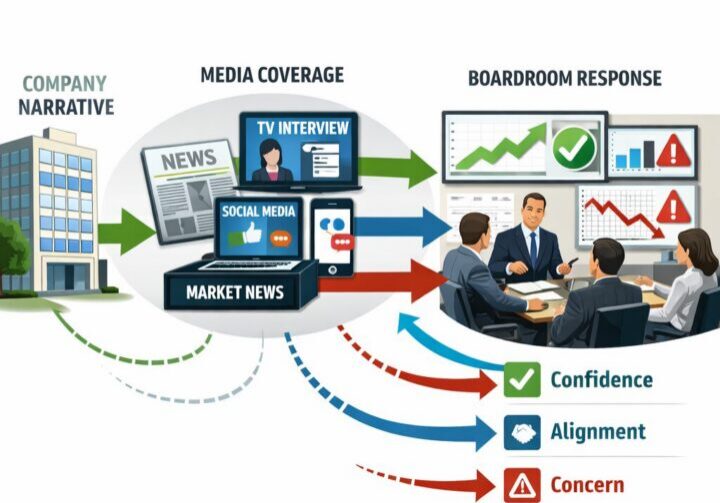

Board members rarely rely on headlines alone, yet earned media plays a subtle role in shaping perception. Directors evaluate how a company is represented publicly and whether coverage aligns with internal strategy.
Media narratives can reinforce confidence or raise quiet concerns about readiness and positioning. Journalists do not write for boards specifically, but their framing carries weight inside governance conversations. These nine dynamics illustrate how earned media influences boardroom sentiment.
1. External Validation of Strategic Direction
When coverage reflects the company’s stated long-term priorities, it reinforces alignment. Board members see confirmation that strategy resonates externally. Consistent framing strengthens internal confidence. Misalignment prompts questions.
2. Executive Credibility in Public Forums
Board members often evaluate how leadership performs under scrutiny. Strong, composed interviews enhance perception of executive capability. Hesitation or inconsistency can create concern. Media becomes a proxy test of readiness.
3. Market Positioning Clarity
Earned media that clearly defines competitive standing reassures directors. Ambiguous coverage raises questions about differentiation. Board conversations frequently reference how the company is described publicly. Clarity supports governance stability.
4. Risk Disclosure Signals
Balanced reporting that acknowledges risk without sensationalism demonstrates transparency. Boards pay attention to how risk narratives are handled. Avoidance or defensive tone can undermine trust. Open engagement builds confidence.
5. Regulatory Framing
In regulated sectors, media portrayal of compliance matters deeply. Board members monitor how governance structures are discussed externally. Inaccurate or shallow coverage may prompt internal review. Precision reduces friction.
6. Consistency Across Reporting Cycles
Repeated alignment between earnings, strategy, and media narratives builds stability. Inconsistency invites board scrutiny. Directors often compare internal messaging with external coverage. Harmony strengthens confidence.
7. Crisis Response Visibility
How a company handles public issues influences board perception of leadership resilience. Measured responses signal preparedness. Disorganized messaging raises alarm. Media becomes a stress-test lens.
8. Industry Influence Indicators
When coverage positions the company as shaping conversation, boards take note. Influence suggests strategic leadership beyond product performance. Directors value external authority. Earned media can highlight that positioning.
9. Long-Term Narrative Trajectory
Boards observe whether coverage reflects maturation over time. A company whose story evolves responsibly signals operational depth. Static or inconsistent narratives raise concerns. Trajectory matters.
Earned media may not be a formal board metric, but it functions as a reputational barometer. Directors watch how strategy translates publicly and whether leadership demonstrates steadiness under scrutiny. Companies that treat earned media as strategic infrastructure strengthen board confidence quietly but meaningfully.