
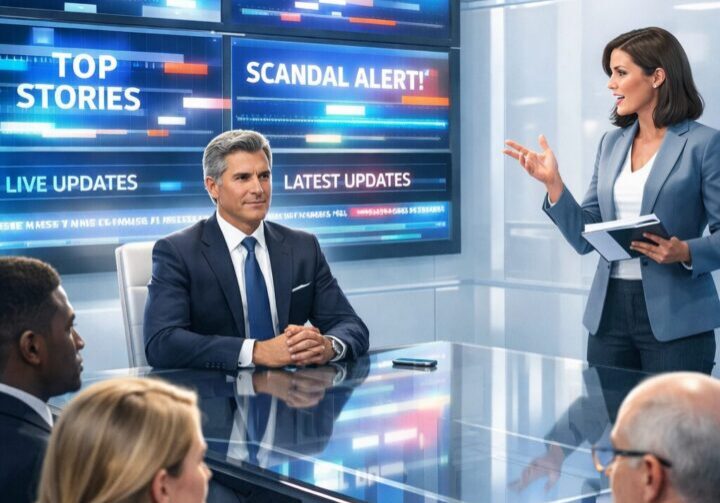

Executives today aren’t judged by full interviews, detailed explanations, or full-context statements. They’re judged by clips, the 8 seconds pulled from a 20-minute conversation, the line lifted from a panel discussion, the snippet that travels on social before the full story even publishes.
This is the reality of modern communication: You are accountable for how you sound in every second of every interview—because any second can become the clip.
In 2026, reporters are under pressure to produce fast, concise, and highly shareable content. Audiences consume information in fragments. Social platforms amplify the most surprising, emotional, or controversial line, not the most accurate one. And algorithms reward brevity over nuance.
For executives and brands, this creates a communications environment where reputation can be strengthened or damaged instantly. Protecting that reputation now depends on discipline, clarity, and media readiness. Here’s how leaders can prepare.
Interviews Are No Longer Linear
Traditional interviews used to follow a predictable arc: open gently, build context, offer perspective, close with a big takeaway. Today, reporters are trained to extract value from every moment because attention spans demand it. This means:
- Any sentence can become the headline.
- Any phrase can become isolated.
- Any hesitation can be misinterpreted.
- Any miswording can overshadow the full message.
Media training isn’t about memorizing talking points. It’s about learning how to deliver clarity at all times, regardless of the question or pressure. Assuring you are in control of what you are wanting to say at all times.
Clarity Is Now a Reputation Shield
Strong media performance isn’t about sounding polished, it’s about sounding unmistakably clear. When leaders ramble, hedge, or spiral into technical language, the risk of misinterpretation skyrockets. Clear communication protects you by:
- Eliminating ambiguity reporters could misquote
- Reducing the chance of clips taken out of context
- Helping the audience understand what you meant, not just what you said
In a clip culture, clarity isn’t only a skill. It’s reputation insurance.
Every Executive Needs a Strategy for “Danger Zones”
There are predictable moments in interviews where risk increases:
- Hypothetical questions
- Multi-part questions
- Questions that blur product and policy
- Questions that mix industry issues with company issues
- Questions about competitors
- Questions about layoffs, regulation, funding, or safety risks
Media training teaches leaders how to navigate these moments with control, not improvisation. Because what gets clipped is rarely the safest part of the conversation.
Rapid Fire = Real Risk
Quick question formats, common in TV, radio, livestreams, and podcasts, strip away the space executives once relied on to think aloud. Under pressure, leaders tend to:
- Speak faster than they think
- Fill silence with rambling
- Use phrases they wouldn’t use on paper
- Reveal more than intended
- Get trapped in linguistic loops
Media training helps executives slow down mentally, even when the format speeds up. The public never sees how the clip happened—only the clip itself.
Your Reputation Lives in the Soundbite
A strong soundbite isn’t luck. It’s engineered:
- Thoughtfully structured
- Intentionally phrased
- Aligned to the message
- Short enough to travel
- Strong enough to withstand isolation
Leaders who master soundbites don’t just avoid missteps, they shape narratives. In a clip-dominated world, your soundbite is your first impression, your defense mechanism, and your brand signal all at once.
What This Means for Executives in 2026
Reputation protection is no longer reactive—it’s proactive. Executives must walk into interviews trained, disciplined, and equipped with the skill set to communicate in a world that reduces complexity to seconds.
Media readiness has become leadership readiness. And leadership visibility has become a core business strategy.