

Most companies invest heavily in product strategy, go-to-market execution, and operational efficiency. Far fewer invest in something just as critical: how their leadership team communicates.
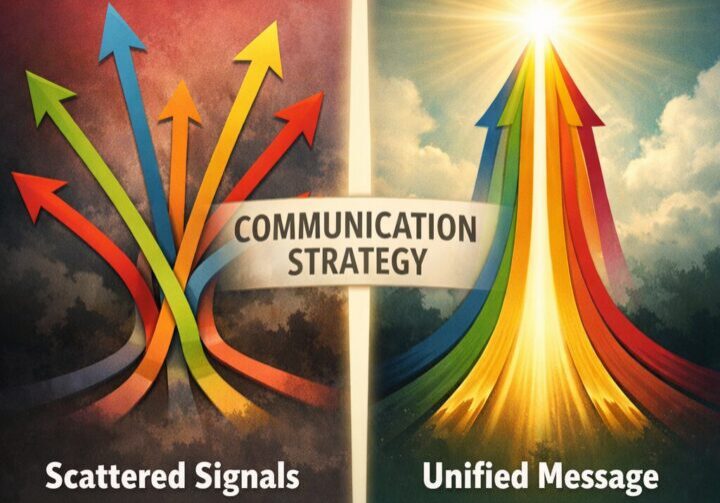
The assumption is that strong executives will naturally communicate well. But in practice, leadership communication is rarely aligned, often inconsistent, and frequently reactive. Different executives emphasize different priorities. Messaging shifts depending on the audience. And over time, the company’s narrative becomes fragmented.
This creates a subtle but significant problem: stakeholders don’t know what to believe about the company. A leadership communications strategy solves this by aligning how executives think, speak, and represent the organization externally and internally.
Misalignment Starts at the Top
When executives operate without a shared communications framework, each leader fills the gap with their own interpretation of the company’s story.
- The CEO focuses on vision
- The CTO focuses on product
- The CRO focuses on revenue
- The CMO focuses on positioning
Individually, each perspective may be valid. Collectively, they can feel disconnected. To external audiences, this doesn’t look like depth, it looks like inconsistency.
Consistency Builds Credibility
Stakeholders evaluate companies based on patterns. If messaging changes depending on who is speaking, credibility weakens. A communications strategy ensures that:
- Core messages are reinforced across all executives
- Key themes remain consistent across interviews, events, and content
- The company narrative is clear regardless of who delivers it
Consistency doesn’t limit leadership voice — it strengthens it.
Executives Are Interpreters, Not Just Leaders
Leadership communication isn’t just about representing the company. It’s about translating complexity into clarity. Executives are expected to:
- Explain industry shifts
- Provide perspective on change
- Clarify what matters and what doesn’t
- Help stakeholders understand direction
Without a strategy, these interpretations vary. With one, they reinforce each other.
Reactive Communication Creates Risk
When companies lack a communications strategy, leadership messaging becomes reactive:
- Responding differently to similar questions
- Over-explaining under pressure
- Introducing new ideas that haven’t been aligned internally
- Contradicting prior statements unintentionally
This creates confusion, especially in high-stakes environments like investor conversations, media interviews, or crisis situations. A leadership communications strategy is not a branding exercise. It’s an alignment system.
When executives communicate with shared clarity:
- The company becomes easier to understand
- Trust builds faster
- Media coverage becomes more accurate
- Sales conversations become more efficient
- Internal teams gain confidence in leadership direction
Strong companies don’t just execute well. They explain themselves well.